|
|
Cause of the M3W Bevel-Box noise
problems.
Most of
the 5-speed M3W owners know the laud weening noise of the Bevel-box when
driving somewhere between 60 and 90 km/hr. The
cause is probably a vibration-resonance created at the teeth of the
Crown-wheel. We
have reconditioned now several Bevel-boxes which we bought from M3W-services
France. After
extensive research thanks to all who have published about this subject in TM
( Talk-Morgan ) - and work we found that we nearly not had to calibrate the
crown- and pinion wheels with less or extra shims. We
also found that the Timken bearings used by Quaife are the best you can get for this
purpose. But
on those Bevel-boxes the bearings were all gone. Which
the knowledge we have now we are pretty 95% ? - sure that they are gone
because of the extreme pressure on the bearing rollers through the use of a
belt-drive. People
have to tight the rear wheel belt enormously and the rear wheel shaft/spindle
nuts are tightened too with extreme force to keep any found alignment in
place. What
everybody seems not to know is that most drive belts nowadays are reinforced
with Kevlar. Because
the belt is so tight it gets very hot. The temperature
coefficient of Kevlar is negative, so the belt is even more tight with that
heat. Although
Kevlar is suitable for a wide range of temperatures, it has a negative
thermal coefficient of expansion, meaning that it shrinks as the temperature
rises and lengthens as it cools. Since this behavior is the opposite of most
other machine components (especially those made of metal) which expand as
temperature increases and contract as temperature decreases Kevlar-reinforced
belts may not be suitable in environments with significant temperature
fluctuations. And
with temperatures around 120 ᵒC this is exactly where we are talking
about. Forces
on bearing rollers. Loose
bearing rollers is already a cause of misalignment for the Crown-wheel teeth
and will create a great change that you will ruin more in the Bevel-box than
only the bearings. Bearings
conical bearings too - do have a small toleration for tangential forces, in
which case you are ruining them. The
use of Conical bearings in our bevel-box do have the main purpose to keep the
teeth of the Crown-wheel and pinion wheel in place with the assistance of
shims. Shims
are tiny tiny round hard steel plates to calibrate
the exact place of those teeth. We
like to explain some of the research we did : The
problem of the Bevel-box bearing is that you create a tangential very small
bearing load-zone when using a Belt-drive. Timken has of lot of documentation about this
subject: The
arc defined by the rollers supporting the load is called the bearing load
zone. The load zone is significantly influenced by bearing setting or
internal clearance, either radial or axial depending on the bearing type. A
larger load zone gives longer bearing life. This
drawing of Timken tells enough. I
made the conclusion that the bigger the load-zone the longer the bearing
life. With
the high and tight axial pressure due to the belt drive you create a smaller
load-zone: Just a few rollers will take all that the pressure-force. And
explains herewith why the life of the bearing in case of a belt drive is far
shorter then with a chain-drive and an extreme raise of the temperature in
the Bevel-box. The
chain drive protects you against this for most of the time. Instead
of a Belt drive which is so tight that you can only turn it in the middle for
a quarter or max half a turn , the chain has a flexibility of at least 4 cm
vertically in the middle. With
a chain-drive - in case you are not using the car - there is no pressure on
the bearing-rollers and when idling - and that s half of your driving time -
there is no tangential pressure either on the bearing-rollers. With a
belt - when not driving - you are still pressing all the oil out of your
bearing-rollers and when you go out for nice drive - for at least - the first
km you have dry bearings so extreme friction, heat and wear. The
other problem with the driving belt is that also the rear wheel bearings and
the swing arm bearings get far too much tangential pressure. So you have to
renew them also more often. Shims
and calibrating the crown-wheel
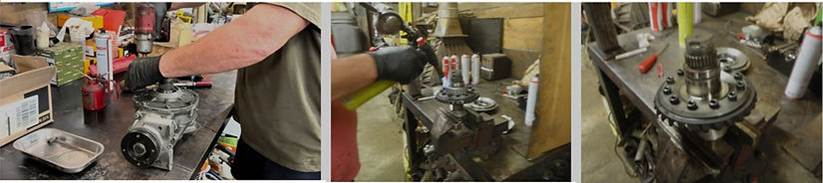
On
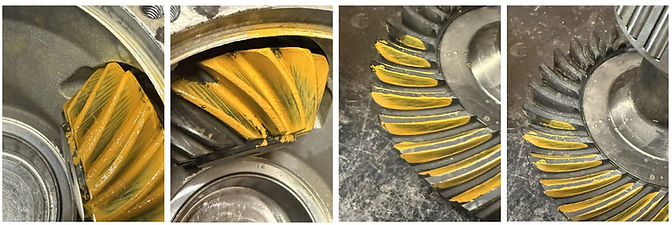
every Bevel-box we get we do extensive research on the crown-wheel. First
we control the steel quality of the teeth by checking on sight. When we think
something is dubious we use fine-measurement tools to get more exact
comparable figures. On
the Bevel-boxes - we worked on - we did not find serious enough problems with
the teeth. Our
conclusion is that Quaife used the best available
material for the crown- and pinion-wheel. Of
course you will get some wear and tear on those teeth after many
ten-thousands of miles, but in our examples we could easily calibrate old
Bevel-boxes with some very thin shims. We
kept the same shims at each side and after checking and cleaning them we used
them as the primarily calibration. Leaking
oil seals There
are a lot of stories about the oil seal which starts leaking, but most
questions about them are very simple to be answered. Our
answer is different from what some owners tell on TM. We
found that the main problem is to be found in the quality of the standard
oil-seals used. Standard
oil seals will break off when the oil temperature comes above 80 ᵒC. The
more expensive Viton seals - the simple ones above max 130 ᵒC. The
top quality Viton to 220 ᵒC. As
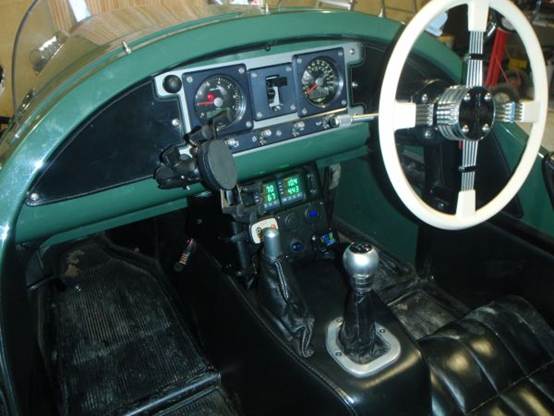
part of our Bevel-box research-project I made a specially dashboard to check
pressures and temperatures everywhere on the M3W, so also the Bevel-box
temperature.
I
tested this for the last 2 years. My
noisy bevel box gets easily temperatures of 120 ᵒC or more under power
for instance mountain climbing in the Pyrenees, where we live - and 85 ᵒC
till 95 ᵒC when just driving. On
none of the Bevel-boxes - we have worked on - the oil-seals did not have
these quality Viton seals. We
advise to check the temperature allowance of every oil seal even Viton -
before installing them. Bevel-box
temperature The generation of heat is
a normal reaction, metal rubbing against metal creates friction and so creates heat. So it
is cause to create as less friction as possible. As
described above, the extra heat produced in the Bevel-box is mainly caused by
the load-zone on the rollers of the bearing and the pressure on the
Crown-wheel teeth when misaligned. With
a tight adjusted Drive-belt the pressure on the bearing creates a lot more
heat because of the extreme small load zone and then created wear on the
rollers which will create extra misalignment on the teeth. Extreme
heat is a problem for a good functioning of the Bevel-box. Think
about expansion between the aluminum body and the steel bearing fitting ,
although when you calculate this, the difference between is neglectable. Find a more detailed answer under : Recently Asked Questions and Answers To
reduce the overall temperature of the Bevel-box we removed the standard NVH
kit on which the Bevel-box is fitted. It
gives the possibility to create more fresh air on the Bevel-box body. It
also creates the possibility of a better alignment and so less friction and
less noise. Find
a more detailed information about this subject under : Being good Aligned is an issue to consider We
installed a kind of air duct, which reduced the temperature most of time with
> 30 ᵒC. An
important function of lubrication oil is not only lubrication but cooling. Timken
: When
heat must be carried away from the bearing, oil must be used. It is almost
always preferred for very high-speed applications. I
tested thicker and especially more oil. Amsoil 250 severe gear. The
cooling is far better and the bearings are always at least half in oil. Stories
about too much oil that will ruin the oil seals are excuse me - nonsense, it
is the high temperature or just aging. I
experimented till 800 ml and never got any foam. I can easily see the
building up of foam because I installed a separate filling tank. And I
never got any leaking oil-seals as has been warned for. I explained already
above the reason for those leaking oil-seals. Oil-vent
and inlet. We
found that every Bevel-box we have seen have still the especially made inlet
for a vent and filling on top of the Quaife
Bevel-box. At the
inside of the body it is very well designed with a splash protective wall,
but outside they were all closed. It is
a far better place to vent and fill oil compared to what MMC Morgan Motor
Company is now doing at starboard side in the middle of the Bevel-box. It is
clear that Quaife created this standard, but MMC
did not know how to fit this option with the by them designed frame-work. We
could not find any reason for this decision. Making
a hole and tapping threads is easy. And using a knee solves the
problem of getting the Bevel-box inclusive that knee under the frame-work. In that case you get the
air vent really at the top of the Bevel-box which is absolutely better than
the existing place, and you can connect it to a small oil-tank to control
foaming and make filling the Bevel-box also easier. When filling a
differential you always have to check on foaming, which ruins the lubrication
capacity of the oil for that moment. When the oil starts foaming you have
either too much oil or the oil is too hot. With a little tank you
can check the results of faming easily, because foamed oil stays in that
foaming phase for a while and the thin foam can easily find its way from the
Bevel-box to this tiny the tank. Standard we deliver a
reconditioned Bevel-box with the new top-inlet and the original side inlet
both plugged.
Simple
draining the oil out of the Bevel-box. We
found at Stahlbus Germany a simple device to drain
lubrication oil. We installed it earlier on our S&S engine so we could
really easily drain from the bottom of the sump without damaging the weak
aluminum thread anymore which is a common issue on these engines. We
used the same Stahlbus drain for the Bevel-box.
This has the advantage that you also can control ones in a while the level of
the oil in the Bevel-box by just keeping the plastic tube up. Temperature
sensor. On a
reconditioned bevel-box we like to install a so-called PT100-thermo-sensor
which you can connect to nearly every standard gauge to you own choice. We
have installed the Auber Gauges because of the multi possibilities you can
have with them. Our results. The
result of our reconditioned bevel-box even impressed us immediately when
driving. Our
standard driving tests of more than 400km for each Bevel-box showed us that -
due to our research and work - we have no Bevel-box noise anymore. That
s the reason we do not hesitate to give a guarantee on our work for 6 month. Important
lesson learned It
learned us too that the longer you drive with a noisy Bevel-box the greater
change you have you will ruin more in the Bevel-box than only the bearings. Most
obviously first the bearing-seats in the aluminum body-work and because of
the misalignment the teeth of your Crown-wheels. Temperature Our
reconditioned Bevel-box has a lot lower temperature, driving cruising speed
not climbing mountains : 65 ᵒC to 75 ᵒC. That
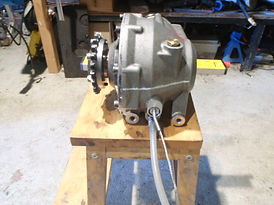
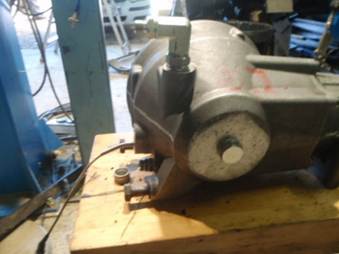
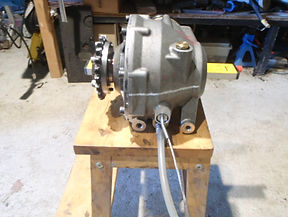
temperature difference explains also a lot. The recon
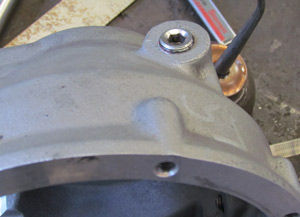
bevelbox with tempearure sensor abd oil-drain and on top the renewed oil
inlet. The renewed
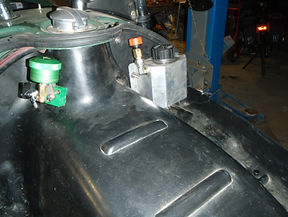
oil-inlet closed. Right
: the 1 liter oil tank. Left
: my chain-oiler device. Explanation what we can do for you. - A
Bevel Box reconditioned by us - Our
Pricing is made with the assumption we get a noisy but reasonable good
Bevel-box from you. You were still driving with it but you want to get rid of
the weening noise of it. Using
what we paid to M3W-services we assume a value of a reasonable Bevel-box is
1500. -
Normally you will send your bevel-box to us. We
assume that we will first receive the old bevel box with a transport
crate/packaging supplied by you. We
will then return the reconditioned one in the same crate. - In
case we have to ship a reconditioned Bevel-box first to you, we will use our
special made shipping crate, which incurs extra costs. In
this case you also have to pay an extra deposit too in wait of the return of
your bevel-box to us. Anything
is possible. -
When we start to work on your Bevel-box it is important to get first an idea
of the quality of those teeth, because misalignment can damage the teeth of your Crown-wheels. . We
then check the aluminum
seats of the bearing in the body-work of your Bevel-box, when wrong we will
see friction patterns on it. When
there is any considerable not by us repairable - damage found, especially on
those crown-wheel teeth we maybe come to a conclusion there's no point for us in fixing anything. That s the reason why we
will check this first, make pictures and send those to the owner for further
discussion or with the advice to buy another one from us. We will offset our costs
with your deposit. By the way,
because of spare parts we are still interested in old 5-speed
M3W-Bevel-boxes. - Any
upgrades. We recommend some upgrades, but they are not
necessary for installing a refurbished Bevel box. Some
upgrades also need to be ordered by us, you can do that yourselves too. Such
as: - Chain
drive Phil Bleazey has sold the business to a Swiss firm. Phil Bleazey sold it 2 years ago for UKP 716 including 530
Tsubaki chain and exclusive shipping of the order and the customs issues of
UKP 150, but I don't know what the new distributor is asking. You
do have to choose the number of teeth for the front and rear sprocket
yourself. If
you are a regular rider who occasionally rides in the mountains, our
experience is that a ratio of 23 in the front and 48 in the rear works best
for a 530 chain. To
see how and why it was installed, see Phil Bleazey
video : https://youtu.be/rMz6rA3ROac The
discussion about the ' noise ' of the chain versus the belt is also well
explained by Phil from 6:15 onwards. - chain
lubrication system When
you make a choice for the chain drive, you'll also need to install a good
chain lubrication system. Expect to pay 100- 200 excluding installation
costs. We
can give some advice. - Bevel
box adjuster Installing
our own developed bevel box adjuster and rear wheel Forward-adjusters . The
Bevel-box adjuster works only on Phill Bleazey s Bevel-box mount . See
the 7:30 mark - https://youtu.be/rMz6rA3ROac - for an explanation of the alignment issues.
We
believe these are seriously underestimated, and we've made several
modifications to address them. We
can provide you with one or two rear wheel "Forward-adjusters See
the item : "Additional Conversion kit" - We recommend replacing the NVH kit with
(partially) that of Phil Bleazey The
installation of the bevel box remains unchanged with or without the NVH kit. One
reason to remove the NVH kit is to provide a more stable mounting of the
Bevel box. See the Phil- Bleazey video. Another
advantage is that you can create an air scoop to better cool the Bevel box,
something others have done. As explained above : Proper cooling of the Bevel
box is very important. - Phill
Bleazey s Bevel-box mount http://www.bleazey.co.uk/M3WBBinstallationmanual.html Phil Bleazey sold those 2 years ago for UKP 916 , but I don't
know what the new distributor is asking. When
you decide to install the Phil-Bleazey bevel box
supports, we would also recommend that you use the alignment tool we
developed devices to install . See
the menu "Additional Conversion kit" The
installation costs of this item is included in the bevel box installation. What to do? Of
course, you can only obtain a reconditioned Bevel-Box from us. If
you - like us - are convinced that alignment needs to be improved, we
recommend the upgrades discussed. If
you are convinced that a chain drive is better than a belt drive, we
recommend those upgrades too. |
|