Recently
Asked Questions and Answers
|
|
Q. One owner wrote us that he thinks the main problem
is that the crown wheel bearings in the case come loose as the case expands
with heat and that allows the teeth clearances to change….sounds reasonable? He says if you warm the case (disassembled) with a
hot air gun the bearing tracks will drop out at quite a low temperature. A: Yes we use at heat-torch too for getting the
bearing seats out, but the heat created by a torch is locally far more than
the heat when running the Bevel-box and also more on the spot. Be aware that the melting point of aluminum in its pure form is approximately 660 ᵒC, so quite low for a Torch. Next , to get the bearing seat loose you only need a fraction of a millimetre to get the
bearing out, which is not supported anymore at the other side of the
crown-wheel spindle. However, after our careful investigation, we
have found no reason why this idea has any significant impact on the
Bevel-box problem. No signs of any serious wear in the aluminium beds were
the hard steel bearing houses are fitted in Expansion coefficient of aluminium and steel
(of the bearing housing) These are for At 20-100 ᵒC aluminium: 23.6 10^-6 mm per ᵒC And for hardened stainless steel: 17.3 10^-6
mm per ᵒC So the difference is approximately a factor of
1.4 Or in a different way explained For 1 meter length Stainless steel from 20ᵒC to 80ᵒC 1 meter of material Linear expansion with ΔT of 60ᵒC = 0.00096 m Linear expansion coefficient of stainless
steel: 16.10-6ᵒC Steel from 20ᵒC to 80ᵒC 1 meter of material Linear expansion with ΔT of 60ᵒC = 0.00072 m Linear expansion coefficient of steel: 12.10-6ᵒC Aluminum Linear expansion with ΔT of 60ᵒC = 0.00139 m Final length with ΔT of 60ᵒC = 1.00139 m Linear expansion coefficient of aluminum:
23.2.10-6ᵒC So you are talking about tiny differences. However, the volume of the aluminium housing
is considerably larger than that of the stainless steel ring of the bearing. The bearing temperature is also considerably
higher - say, 80ᵒC - than the much better cooled solid exterior
of the aluminium housing - say, 55ᵒC. That already compensates for that factor. Furthermore, with proper adjustment using the
shims, the bearing fits so tightly that any expansion will only push the
tapered bearing further into its steel fit. If expansion were to cause a difference, we
should also see it in the alignment of the crown-wheel teeth. We haven't observed this in the three boxes
we've worked on. What we have observed is the typical wear of
the tapered bearing under tangential loads. Q: I am not convinced about the
benefits of a chain drive being worth the expense and effort. I did install one for a
while, along with an electronic Scott oiler, it wasn’t a miracle cure.
Better tyre clearance, easier alignment but
also and chain/sprocket wear and maintenance instead of belt alignment and
tension. A: I know. And you are not the only one. But . . . The Chain drive is not that expensive and
maintenance makes it cheaper than Belt drive for the owners who have to go to
a specialist. Changing the chain is also far less time and
money consuming than the Belt drive. On race- and off-road- motorbikes they left
the idea of using a the belt-drive too because of the severe gear problems
they got with it. Also the very well designed trike Polaris
installed standard – after a lot of research - to the chain drive again. There is a lot of discussion on the internet
too – pros and cons - when interested, read : https://dreisilker.com/blog/how-improper-belt-tension-can-affect-your-belt-drive-system/ https://www.indianmotorcycles.net/threads/damage-from-tight-belt-signs.327769/ https://wheretheroadforks.com/chain-vs-belt-drive-bike-pros-and-cons/ https://www.advrider.com/shaft-belt-or-chain-drive/ https://www.reddit.com/r/motorcycles/comments/134iyv/belt_drive_or_chain_drive_which_is_better/ Q: So basically the main changes were to replace the bearings? You had no
issues setting the pinion teeth engagement clearances? A: Unfortunately
that’s not clearly the case. We
still had done a lot of tuning with shims to find the right teeth clearances
or alignments. And
we will have to do this on every box we get for a reconditioning, because we
were – and are - never sure. And
we were informed of that some owners let done only changing the bearings but
it did not solve the noise issue enough. As happened to some well-known TM
commentators. That’s
the reason we will make pictures of the internal situation and the work, so
the owner gets real information about what has been done. Q: When you say "We found that we nearly not had to calibrate the
crown- and pinion wheels with less or extra shims" - do you mean you
almost always had to change the shims? or that you found that wasn't the
problem? A: Yes,
we had to take the old shims out, but it is very important that we have to
keep them apart – of both sides – so you know which were installed where. But
cleaning and controlling them with the crown-wheel teeth was most of the time
enough. We bought several very thin new shims which we used for fine-tuning
in case we needed them. Q: A: This
is a more difficult topic to answer and has costs us the most research time
to understand the problem and to be sure we were on the right track. It is
also subject to a world of discussions within the M3W family. The
belt drive In
our opinion the belt drive is the main reason for all the trouble. I.
You have to tight it too much. In that case there will be always
enormous pressure on all bearings, not only the bevel-box bearings but also
the rear-wheel and swing-arm bearings. And this pressure creates heat and
‘wear and tear’. But
the problem of the Bevel-box bearing is that you create a tangential very
small bearing load-zone. Timken
: “The arc defined by the rollers supporting the load is called the bearing
load zone. The load zone is significantly influenced by bearing setting or
internal clearance, either radial or axial depending on the bearing type.” “ A
larger load zone gives longer bearing life.” This
drawing of Timken tells enough. I
made the conclusion that the bigger the load-zone the longer the bearing
life. With
the high and tight axial pressure due to the belt drive you create a smaller
load-zone: Just a few rollers will take all that the pressure-force. And
explains herewith why the life of the bearing in case of a belt drive is far
shorter then with a chain-drive. II.
The other problem is that with that extreme tight drive-belt the
tangential friction on the bearings will create heat too. Timken
: “When
heat must be carried away from the bearing, oil must be used. It is almost
always preferred for very high-speed applications.” Timken
: “HEAT
DISSIPATION The
heat carried away by a circulating oil system. In a
splash lubrication system, cooling coils may be used to control the bulk oil
temperature.” III.
With the current - only rear-wards - alignment possibility the rear
wheel tents always to switch to starboard. How tight your turn the Spindle
nut at the end you will always find after a while a slightly
looser rearwards-adjuster at starboard. Which
will always give mis-alignment between the bevel-box-sprocket and the
rear-wheel-sprocket. And which creates again extra friction and so heat with
all the consequences. IV.
The oil is pressed out the teeth of the crown-wheel when you are
not driving. And
because our M3W’s are fun trikes they do not make much mileages. So the time
the rear-wheel is not turned, at the same time the oil will still be pressed
out of those teeth. Not with a loose chain. Do
not forget that even MMC has changed the belt drive on the super-3 back to
chain drive. And on motor-bikes it is only used in ( HD ) touring bikes. Even
the nice Polaris-trike which have far more torque than our M3W uses a
chain-drive. So we
do not recommend slackening the Belt-drive, because it will skip on his
teeth. When
owners want to continue with a belt drive they should do, but not be
surprised that the whining issue comes back after ??? miles. A
belt tensioner is not strong enough to handle the necessary torque on the
belt. The teeth of the belts are too short. Conclusion
out of I , II, III, IV : Actually
the case is that you should get rid of this belt-tension, which seems to me
is - with our current knowledge - not possible. That’s
why I installed a Chain-drive. -
The increased oil Increased
oil has more than one reason. First
it cools better and cooling the Bevel-box is very important. I
made an extra dashboard to check interesting temperatures and I have measured
quit high temperatures in the Bevel-box. Even to a level that standard
oil-seals cannot handle it. Increased
oil volume keeps also minimal half of the crown wheel teeth constant
lubricated. The advised 300 cc does not even nearly lubricate the lower
teeth, only by splashing. Think
about this when the M3W is not used for a period. -
Changing the bearings This
should not be a regular item as long as you keep the temperature low, half of
the Crown wheel teeth lubricated and the mean bearings also at least half
lubricated, like actually is the case at nearly all car-differentials I know. But
that said . . . Having a belt will damage the bearings of the Bevel-box, rear
wheel and the swingarm faster than with a chain-drive. All
the moments you idle – which is approximately half of the time you drive -
with a chain-drive and when the M3W is not used there will be no pressure at
all on all of these bearings, with a belt always. Q: I like the idea of your bevel box alignment rod. I remember asking Phil B
about correct lateral positioning when I installed his bevel box mount. A: I
found it necessary. I
changed already the design of the Bevel-box alignment device to a smaller and
stronger version. But
for the same reason this alignment is necessary for the Bevel-box, It is for the Rear wheel too. In
combination with the Bevel-box alignment device a ‘Forward’ rear-wheel
adjuster is in my opinion a very important device too. You
really have to see those in combination with each other. And .
. . this especially interesting for those who have a Belt-drive. Q: My car has the Morgan NVH kit, I have no idea if this changes anything
about the installation? But .
. . because there is probably a small alignment problem we advise to consider
the PB- Bevel-box mount. See our article about alignment. Q: A: -
Emil Yes
he was a great inspiration for me. Unfortunately I could not ask him
questions anymore. My
main question would be : “Did
you only make an oil-cooling device or did you also checked the interieur
mechanics of the Bevel-box ?” Because
without the latter a cooling device will not help much. It is only a ‘symptom
management’ but the cause of the heat is still there when you do not change
the mechanics of the bevel-box. And
it seems to me that his solution is too complicated and too vulnerable. The
answer of Britmog/Bruce on TM - #837217 - is very interesting “Yes,
Emil did offer a Bevel Box oil cooling kit I have one installed and it does
help. I turn the pump on before moving off to give the bearings a spray it
also increases the oil capacity up to the breather level you can see the
level in the feed pipe. Maybe I should try taking the breather out block it
off and fill it to the 700cc its currently at 420cc as the fill pipe has a
breather on the end which would relieve any pressure.” This
is exactly what you have to do. I think the 700cc or 800cc would do the same
splashing when you start driving the first 20 meters slowly. But
keep in mind my foam-comment at : “The extra lub-oil
tank” As Timken
writes : “In case of a splash situation you need extra cooling coils”. This
is not possible in- or outside the current Quaife
Differential box or you have to consider Emil’s solution. Air-duct Perfect
alignment of the Bevel-box with the rear wheel, changing the bearings, using
more oil ( 800cc instead of 300cc ) and the air scoop/duct, is far more
simple to do with the same cooling results. I
made just a simple scoop, and from several other owners I understood they had
created something with the same idea. But .
. a scoop has only use when you get rid of the standard NVH kit. You
can see the air-scoop just in front of PB’s Bevel box mount. I suppose I have
to change them maybe every 2 years because of the dents of ground contact. I
can lift the car with my suspension, but still . . . I
make them very cheap of standard rectangular Aluminum U-Profile. For
me I got the temperature around 30 ᵒC lower with that simple
scoop. Q: A: The
main reason is a more ‘simple’ filling system for the Bevel-box lubrication
oil. ( It takes some time with the tank and the long Hydraulic ( metal
sheeted ) hose with the thick 250 oil I use ) I
also could check with the tank during my test periods if the oil was foaming.
With foaming the foam will easily build up in this tank and else not. Foaming
tells me there is too much oil, or too hot. But when occurs the lubrication
is not working properly anymore. That’s
a point you should consider when putting more oil in the Bevel-box. Yes,
it is at starboard under the luggage panel ( Boot inner tray ) against
the back bulkhead panel. I
attached it on black fiber board so you can easily take it away and I used a
solar-panel ‘roof cable-inlet’ to cover the hole I made in the
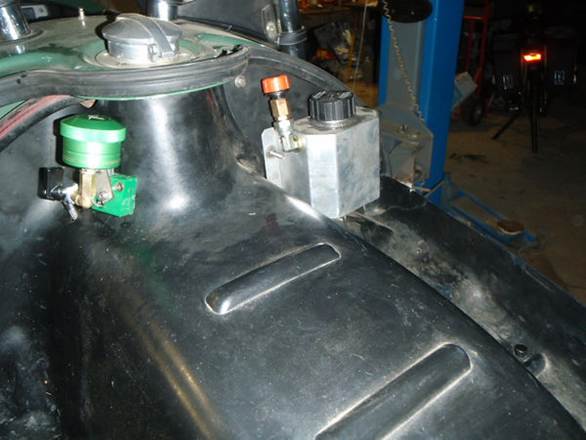
‘Boot inner tray’ to get the oil-line through. On this picture
:Starboard the little tank, Port my little Chain-oiler |
|